Précis
The following project is the most student-centered assignment I created during my undergraduate studies, as students were required to construct their own assignment description and rubric, which we then used to complete our projects. Students posted their assignment ideas to a Canvas discussion board so that peers could form a group and then work on the assignment description and rubric together, making the entire experience collaborative. Before the poems, I have included my assignment description, which essentially asks students to write a series of ekphrastic pieces and then a brief reflection essay where they analyze the connection, if any, between ekphrasis and Surrealism, the latter of which was the course topic. After the assignment description are a sampling of the ekphrastic poems from my project and the analytical essay. Though the essay is not a creative work, I included it to indicate how a student-centered creative project can still include analysis and research.
This final project was completed in Studies in Poetry with a focus on Surrealism, a literary and artistic movement that involved challenging norms, drawing inspiration from dreams and the imagination, and dismissing logic. Though the course centered mainly on poetry, we also read Surrealist essays and viewed Surrealist works of art. To make the course even more interdisciplinary, the professor allowed students, each week, to choose to complete either a creative prompt, an academic prompt, or a collaborative prompt. This course format was highly effective because it gave students the freedom to explore their literary and academic interests, and the course involved extensive collaboration which helped in working through some difficult texts. As the traditional Surrealists believed in freedom and collaboration, the final project was a fitting end to the course.
While student-centered projects like this might seem like a risk, since students are given a lot of freedom, the professor still created basic guidelines. For example, when writing our assignment descriptions, we were required to adhere to the course outcomes provided by the professor. The professor also instructed us to create an assignment description that is challenging enough to fit a 400-level course. Lastly, even for the more creative projects, students were required to conduct scholarly research in addition to including course materials. Although the project was student-led, the professor still aided us throughout the entire process, as we were required to submit a project proposal, an annotated Works Cited, and drafts for instructor and peer feedback. Therefore, this project is a strong example of how assignments can be student-centered and creative, while still being rigorous and academic.
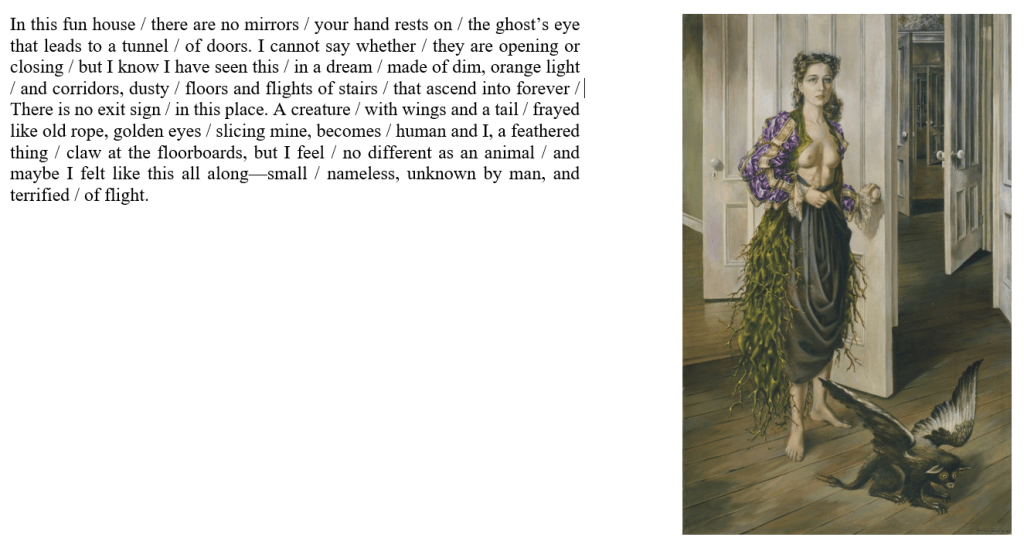
In my poems, I engage with course themes by incorporating Surrealist techniques, such as the use of unexpected images. An example is in the poem, “After Birthday,” when I write, “your hand rests on / the ghost’s eye that leads to a tunnel / of doors.” In these lines, I am describing the imagery in Dorothea Tanning’s painting, but I replace the image of the doorknob with “the ghost’s eye.” As the Surrealists drew inspiration from dreams, which are often peculiar and contrary to reality, I use an image that would appear in a dream rather than reality. That said, my poems are not entirely Surreal, in the traditional sense. Rather than completely mimicking the poems of Surrealists—like André Breton, Robert Desnos, Guillaume Apollinaire, and Federico García Lorca—I combine Surrealist influences with my own, contemporary style of writing poetry. My project drew upon readings and themes from the course but still consisted of original work, meaning that this assignment effectively reaches the top levels of Bloom’s Taxonomy. By understanding and analyzing Surrealist readings, I was able to apply these concepts to my project and create my own work, thus making this assignment beneficial to student learning and growth.
Assignment Guidelines for Surreal Poetry Project
Creative Portion:
Students will need to acquire a minimum of 10 sources (which will likely be in the form of visual art pieces) and write a minimum of 10 ekphrastic poems. However, students have creative license in constructing their ekphrastic pieces. Perhaps, rather than writing traditional poems, someone might be interested in writing their own poetry comic book (see below for more details on this option). Or, maybe someone is interested in making a series of short films in which they choose different poems from other authors and record video clips that are in conversation with those poems (see below for more details on this option). As long as the student explores how image and word engage in dialogue, different versions of an ekphrastic manifesto are welcome.
- Poetry comic book, or individual poetry comic strips: since students would be creating both visual art and poems, their sources may come in the form of other poetry comics used for stylistic inspiration and possibly even imitation.
- Poetry short films: Since creating such films will likely include more work, what with filming and editing, the minimum required number of pieces is 5, rather than 10.
Proposal and Annotated Bibliography:
Before embarking on the Creative Portion of the assignment, students will write a short proposal (between 100 and 300 words) detailing the type of ekphrastic pieces they wish to create. If the student has alternative ideas not listed in the creative portion of the assignment, they should make a case for why their idea constitutes as ekphrasis. Along with the proposal, students must include an annotated bibliography listing their sources, with 3-5 sentences on how the student plans to use these sources in their ekphrastic project.
Reflective and Analytical Portion:
After the aforementioned creative portion of the assignment is complete, students will write a reflection paper (two full pages minimum MLA format) in which they examine how ekphrastic poetry does and/or does not invoke Surrealist ideals. More specifically, students may discuss how the interaction between word and image creates a bridge between imagination and reality. In addition, students should analyze, in their paper, how their creative pieces are in conversation with other works of art and how drawing inspiration from artwork affected their process, generated new ideas, et cetera. Include an annotated bibliography consisting of sources used for the creative portion of the assignment and any additional sources that may have been used for the reflection paper. In the annotations, write 3-5 sentences explaining which elements of the source (i.e. color, mood, interpretations of meaning) influenced the creative manifesto. Both the reflection paper and Works Cited should adhere to MLA formatting standards.
A Sampling from “Steel, Strings, and Other Supplies for Reconstruction”
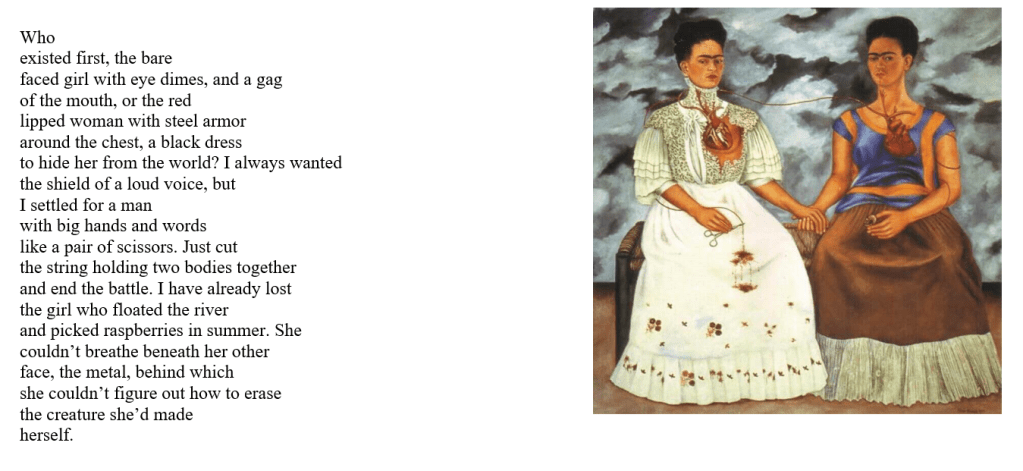
The Two Fridas
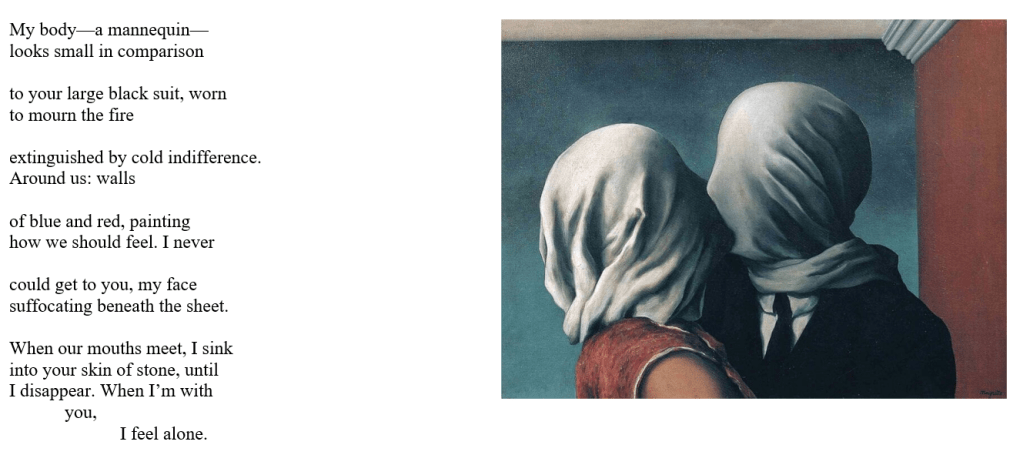
After The Lovers II
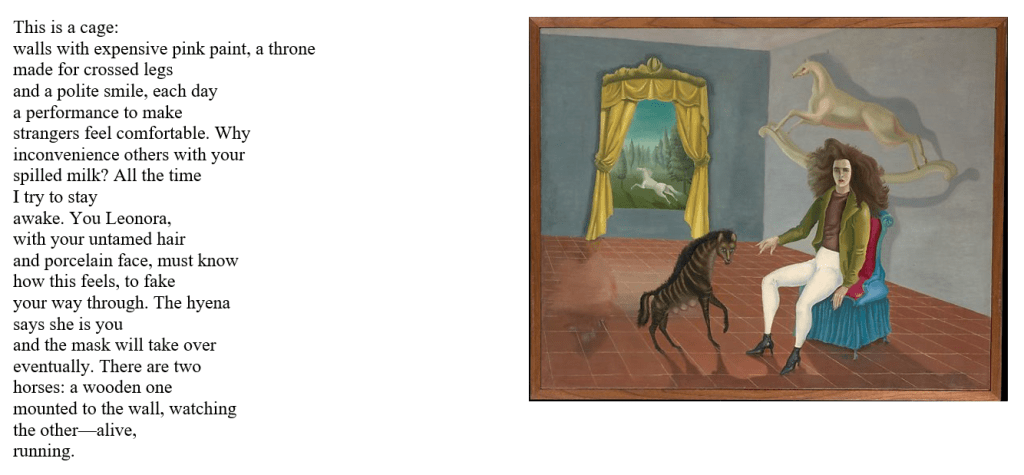
Self-Portrait
After Girl Before a Mirror

After Birthday
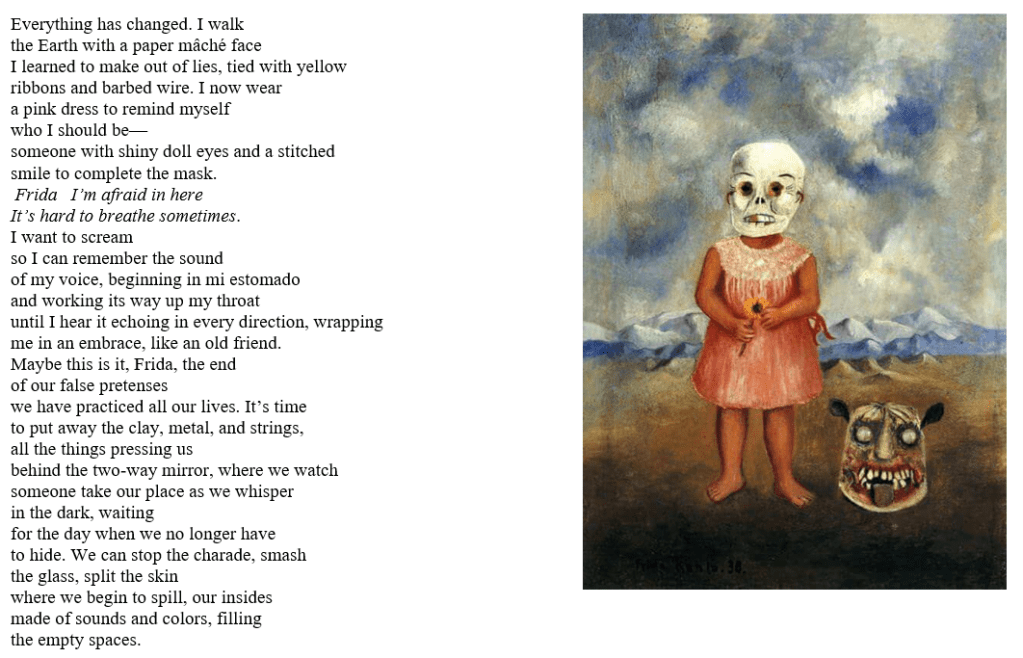
After Girl with Death Mask
(Frida Kahlo’s painting and Jennifer Givhan’s poetry collection)
Conversations and Connections: The Ekphrasis Process and Integrating Surrealist Influences
Some may argue that Surrealism grounds itself solely in the imagination, with its goal to escape the confines of consciousness. However, to define Surrealism as an illustration of only the subconscious would be to greatly restrict its possibilities, and, therefore, go against the ideal of breaking social and artistic norms. After reading and writing poems with Surrealist influences, I find that Surrealism is a very fluid genre—a channel between ideas, worlds—as André Breton describes, “[P]ure expression” (26). Many Surrealist works, including but not certainly limited to, Paul Éluard’s “Identities,” take an image grounded in nature (i.e., reality) and transform it into a more imaginative, abstract image: “The volcano beating like a heart unveiled” (15). Furthermore, Surrealism forms a link between reality and imagination, developed through the frequent use of vivid imagery and conversation across artists and infleunces.
Imagery and visual art played a large role in the Surrealist movement, shown in the contributions of painters like Frida Kahlo, Remedios Varo, and Salvador Dalí. These visual artists demonstrated, not only to other visual artists, but also to writers, how to construct an image that defies realism. Dalí’s paintings of melting clocks, as an example, generated new ideas for what art and literature could become—works able to make dreams and imagination more tangible. Since Varo both painted and wrote, she especially connected the visual and written art forms, as her poems appear to have been heavily inspired by images and dreams (Varo). Contemporary poet Cees Nooteboom’s Self-Portrait of an Other consists largely of peculiar imagistic descriptions, creating a nightmarish atmosphere surrounding the poems. The book also contains visual art by painter Max Neumman; though his visual images do not directly relate to Nooteboom’s poems, the words and images coexist symbiotically, creating a multi-faceted experience. Thus, imagery serves as an integral part of Surrealism, as the visual arts both inspire and work in tandem with writing poetry.
Surrealism is also a very conversational movement, in terms of the various collaborations that occurred during this artistic period. In this sense, ekphrasis—an artistic and literary genre that involves creating new work by responding to an existing art piece—goes hand-in-hand with Surrealism, especially in the ekphrastic pieces where a piece of writing speaks directly to a persona depicted in a work of art. In fall 2019, I first experimented with writing ekphrasis poetry in response to Surrealist visual art, by writing a poem where the speaker speaks directly to the persona within Frida Kahlo’s The Broken Column. My experience reinforces the ties between Surrealism and ekphrasis. While some of the poems, like “After The Lovers II,” “After Self-Portrait,” and “After The Simulator,” more closely describe items portrayed in the artworks to which they are responding, other poems, including “After The Two Fridas,” “After Girl Before a Mirror,” and “After Girl with Death Mask,” are more loosely inspired by their corresponding artworks. All of the poems, I would argue, create narratives that stem from a piece of art, but ultimately find their own meaning (in the contemporary narrative moment, in meditation, etc.). In this sense, the poems are imaginative, because they are a result of the words, images, and stories I pictured in my mind while examining the chosen artworks. Moreover, the poems are entering a creative dialogue by speaking to, building off of, and reimagining Surrealist artworks, a dialogue that extends over decades, movements, and genres.
In “Poem after The Lovers II” and “Poem after Girl Before a Mirror,” both the form and language are used to describe the corresponding paintings, by Rene Magritte and Pablo Picasso, respectively, while also drawing on my own interpretations. Magritte’s The Lovers II portrays a man and woman kissing, with sheets covering their faces, which could symbolize a lack of emotional connection between the two, despite their physical connection. I chose to break the first poem into couplets, in order to emphasize the physical closeness of the man and woman in the painting; however, I disrupt the form in the final stanza, representing the emotional distance between two lovers. With the second poem, on the other hand, I broke the poem into two side-by-side columns, in order to reflect the image of a girl looking into a mirror, in Picasso’s Girl Before a Mirror. The girl’s reflection consists of darker colors, indicating that the girl has a sort of alter-ego. In my poem, the two columns are conversing, the left one representing the girl who has been imprisoned by her dark alter-ego, represented by the right column. Not only does the poem work linearly, but each column also reads individually, forming a multi-dimensional experience. Therefore, the imaginative and conversational quality of these poems convey Surrealist influences within the ekphrastic genre.
While the ekphrastic poems within my manifesto may not be entirely Surrealist, they draw upon Surrealist values, including dreams, imagination, and conversation. Ekphrastic poetry explores the relationship between language and visual images, allowing the writer to try and enter the painting, or mind of the painter themselves, in order to create possible understandings of meaning. Similarly, in Surrealism, artists attempt to enter an alternate world, whether it be a dream, the imagination, or the subconscious, and consequently find other versions of the reality in which they live. Both Surrealism and ekphrasis are also grounded in imagery, as both recreate images in new ways. Surrealism often takes seemingly unrelated images and combines them in an avant-garde fashion, while ekphrasis, as seen in my own ekphrastic poems, responds to or reimagines a preexisting artwork. Duality is a key quality that exists both in ekphrasis and Surrealism, and this dualistic nature stems from the conversations and connections that occur within these influences.
 Exploding Pedagogy