Précis
For 1980s Literature and History, we students were instructed to create a game using Twine as a platform. This project was one of the most innovative, unconventional assignments I completed during my undergraduate studies and included research, extensive peer and instructor feedback, and multiple rounds of revision. Although the final product is an online game, this project combines literary analysis and research explained in a required précis, and I have reworked mine below. My Twine project is based on Haruki Murakami’s Hard-Boiled Wonderland and the End of the World, which I summarized in the précis for “Conscious Beasts: Poems.” By drawing from descriptions of the mind within Murakami’s novel, and combining this information with research on memories, dreams, and the brain, I created a maze-like game. The object of the game is to find the center of the maze, which represents core consciousness, referred to as “The End of the World” in Murakami’s novel. Furthermore, while a human may not possess full access to the unconscious mind, they still can discover glimpses through dreams and memories, which can help people better understand the functions of their mind and the formation of their identity.
Murakami’s portrayal of the brain’s structure plays a major role in the structure of my game. After the protagonist in the “Hard-Boiled Wonderland” narrative has his mind prepared for the job of shuffling, he is told that attempting to understand his core consciousness is “like trying to slice through a watermelon with sewing needles. They may leave marks on the outer rind, but the fruity pulp will remain perpetually out of reach” (Murakami 113). The “outer rind” of the watermelon functions as a metaphor for the conscious mind, which is what allows humans to experience the world, make choices, and produce thoughts. The “fruity pulp” symbolizes core consciousness, lying deep within the mind where humans cannot travel. I incorporated this metaphor into my game by making the goal to find the center of the maze, rather than to exit the maze. Moreover, the player’s choices throughout the game determine how deep they are able to “slice through” their consciousness and travel closer to the center, or the core of their consciousness. While the game is described as a maze, the structure is a representation of the watermelon metaphor; this demonstrates how my project, while it exists in a creative form, still interacts critically with the text and course themes.
In the novel, the Professor breaks down the functions of the mind for the protagonist and suggests that memories serve as the foundation on which core consciousness is built. The Professor asserts that identity is “[t]he cognitive system arisin’ from the aggregate memories of that individual’s past experiences, and “human beings have almost no grasp of their own cognitive systems” (Murakami 255). This quote plays a major role in my project, since one of the keys to winning the game is making choices related to memories which lead the player closer to their core consciousness. In order to make the game applicable to anyone, I keep the language in the game as ambiguous as possible, since, as the Professor states, “No two human beings are alike” (Murakami 255). His claim infers that every person experiences the world differently which results in each person having different memories, all forming an individualized “cognitive system.” To not have any experiences would mean to have no materials with which to construct the cognitive system; consequently, having no cognitive system would mean death. In my game, after players reach the door that leads to the center of the maze, they have the option to either enter or to remain where they are. This is where a third event from Hard-Boiled Wonderland and the End of the World is integrated into the game; due to a malfunction in the experiment on the first protagonist’s mind, he essentially becomes trapped in his core consciousness where he must give up his conscious mind. In my game, entering core consciousness means leave the conscious mind behind, which is what allows people to experience the world. Even if they remain in the conscious, they are still eternally in the maze until death because the maze represents the mind.
Though my game is largely generated from my interpretation of the aforementioned scenes from Hard-Boiled Wonderland and the End of the World, I chose to explore scientific research on the brain to acquire a deeper understanding on how the mind functions consciously and unconsciously. In the article “Delving within: the new science of the unconscious,” Paulson et al. examine neuroscience literature, and discuss questions such as whether a true self exists in each person, and how conscious and unconscious contribute to the formation of that self. One author proposes that “[t]he self is made up of memories and there’s continuity for this entity of self that we construct,” which corresponds with Murakami’s description of a person’s cognitive system (“Delving within” 16). While there are exceptions to that theory, like how brain damage and other events may affect memory and sense of self, there still appears to be a connection between memory and the unconscious. In addition, dreams can also provide a link to the unconscious. In “Dreaming: a gateway to the unconscious?” Paulson et al. discuss “big dreams,” which are the more impactful dreams that people remember while awake: “I think that’s what big dreams are—getting into a very different state of consciousness from the usual, which enables some perspective that’s growthful and a new experience” (“Dreaming” 38). The authors imply that dreams access an alternate reality, and while this reality is often shaped by what we experience while conscious, there are unexplained aspects of dreams that come from a different part of the mind, possibly the unconscious. Thus, there are options within my game that involve recalling memories and dreaming, both which lead to the center of the maze.
While my game is not based completely on scientific fact, the aim is that players will further understand that the conscious mind is what allows people to experience the world as they know it. If one were to actually succeed in living in their unconscious mind, they would have to give up their experiences in the conscious world, as one cannot exist in both states of consciousness simultaneously. Moreover, memories of past experiences are linked to the unconscious mind, and play a large role in the formation of identity. Dreams and memories can thus help people explore deeper layers of their mind, and the nature of their identity.
The majority of the information above appeared in the précis I wrote for the assignment, proving how innovative assignments can still include analysis, research, and metacognition. Without the précis, my Twine project might appear confusing to readers, as they would not clearly understand the literary analysis and psychology research that inspired the project. If professors are to assign more innovative projects, which do allow students more creative freedom and abstraction in their writing, they should consider requiring a précis. This ensures that students are critically thinking and using sources while also practicing metacognition.
A Sampling of “The Maze” Project
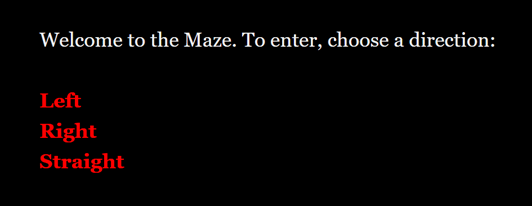
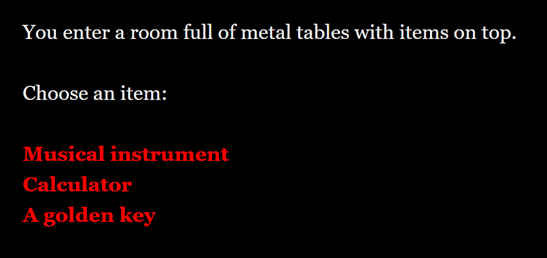
To play, click the link which will lead to the Twine game: The Maze. Below are two examples of scenarios within the game, but there are many more than these two. Players will sometimes have options, as seen in Figure 1 and Figure 2, and they will sometimes have only one choice. Thus, the game is very interactive.
 Exploding Pedagogy